There is a disruption underway that is larger than most people in white-collar professions currently realize.
Artificial intelligence, robotics, and the rapid progress in energy storage and clean energy are not just incremental improvements. Together they represent a technological shift that will reshape entire industries.
Many jobs will change. Some will disappear. Others will emerge. And in IT, many software engineers still believe they are largely safe. I hear variations of the same argument again and again:
“AI might help us write some code, but real software engineering is far more complex. Experienced engineers will always be needed.”
History suggests otherwise.
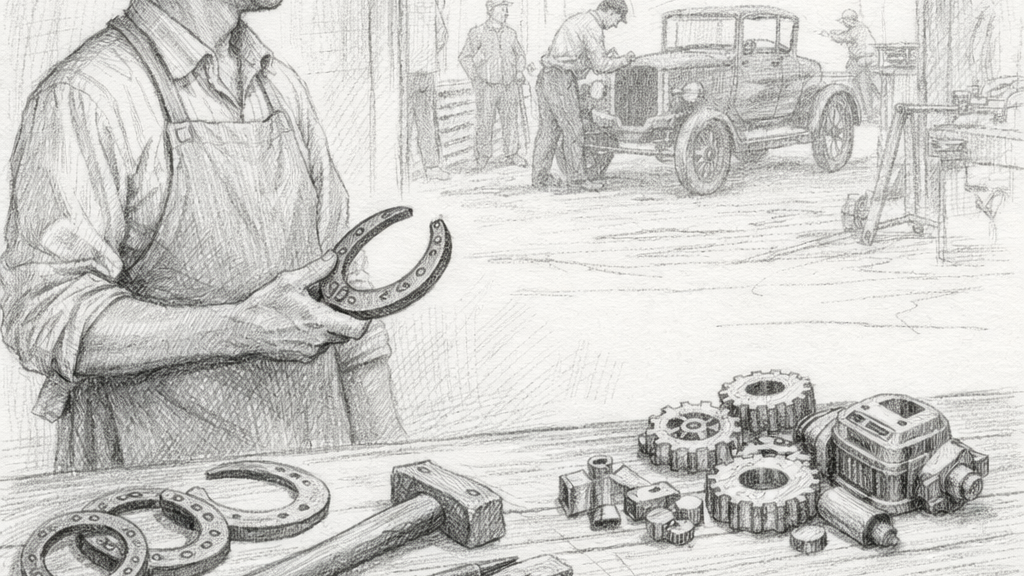
At the beginning of the 20th century, transportation underwent a dramatic transformation. For centuries, horses were the backbone of mobility. Entire professions were built around them: breeders, carriage makers, stable workers, and of course blacksmiths.
Blacksmiths were highly skilled craftsmen. Their expertise was respected. Their craft had been refined over generations. Then the automobile arrived…
At first, many dismissed it as a curiosity. Noisy machines that frequently broke down. Horses were reliable. The infrastructure already existed.
But within a few decades, horse-based transportation had largely vanished.
Some blacksmiths reacted by doubling down on their craft. They focused on becoming even better horseshoe makers. They perfected techniques that had been valuable for centuries.
Unfortunately, the market they served disappeared.
Others saw the shift early. They recognized that their deep understanding of metal, tools, and mechanics was still valuable. They moved into the emerging automotive industry. They became mechanics, machinists, or early mechanical engineers.
Their craftsmanship did not become obsolete. It simply found a new context.
We are at a similar moment today.
Large language models can now generate code at a speed and quality that was unimaginable only a few years ago. The gap is shrinking rapidly between what a highly experienced engineer can produce and what an AI system can generate with the right prompt.
This does not mean software engineers are no longer needed. But it does mean that writing code alone is no longer the scarce skill. The scarce skill is understanding what should be built in the first place.
AI can generate functions, classes, services, and even entire applications. But it still requires guidance.
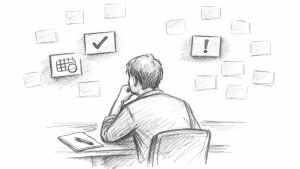
What is the product we are trying to create?
What business process are we trying to automate?
Why does this process matter?
What are the rules that govern it?
Where does the value for the customer come from?
And how do all of these elements interact over time?
These are not coding questions. They are product and business questions.
This is why I often say that software engineers must evolve into product engineers.
A product engineer does not start with technology. They start with understanding.
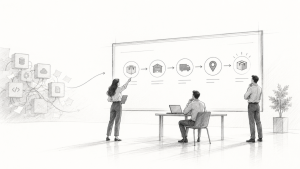
They understand the business domain. They understand the problems worth solving. They can model the activities, decisions, and outcomes that define a business process.
Only then do they use technology to implement the solution.
In many of my previous posts I described modelling techniques that focus on a small number of fundamental building blocks. These approaches shift attention away from frameworks, languages, and infrastructure and toward the structure of the business itself.
This capability will become increasingly important in an AI-driven world.
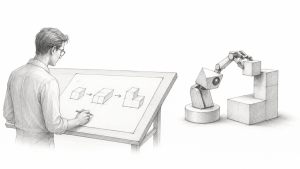
Because while AI can generate code, it still needs someone who can clearly describe the system that should exist.
Someone who can turn a vague business problem into a structured model.
Someone who understands the difference between a feature and a capability, between an activity and an outcome, between an event and a state change.
In other words, someone who understands the product.
Those who cling to the identity of “code specialists” may find themselves in the same position as the blacksmith who perfected horseshoes just as automobiles took over the roads.
Those who expand their perspective, who learn to model businesses and design products, will remain indispensable.
The tools are changing rapidly.
But the need for clear thinking about how businesses work and how value is created has never been greater.
And that is where the next generation of engineers will make the real difference.
Originally published on LinkedIn (2026-03-08): https://www.linkedin.com/pulse/ai-disruption-why-software-engineers-must-become-product-schenker-yqn6e