Governance usually enters the picture with good intentions.
Something went wrong. A production incident happened, a risk materialized, an audit raised questions, or a dependency surprised people. In response, we add reviews, checkpoints, approvals, controls. Not because we enjoy bureaucracy, but because we are trying to prevent recurrence. Governance, in that sense, is a reaction to uncertainty.
The problem is that governance is most often applied at the wrong level, and at the wrong time.
Most governance models assume that behavior needs to be controlled because it cannot be trusted. They attempt to reduce risk by restricting action: who may change what, when, and under which conditions. The underlying assumption is rarely stated, but it is clear enough: if we can slow things down and introduce enough oversight, problems will be caught before they cause damage.
Yet in practice, governance rarely fails because people bypass it. It fails because it arrives too late to be effective.
By the time governance mechanisms engage, execution has already begun. Decisions have been made implicitly. Trade-offs have been accepted without discussion. Assumptions have solidified into structure. Governance is then asked to provide safety in a space where understanding is already fragmented.
This is why governance so often feels like friction rather than guidance. It is asked to compensate for missing clarity, not to reinforce it.
What governance actually needs in order to work is not more authority, but more visibility.
Risk does not emerge from action itself. It emerges from action taken without shared understanding. When the structure of a system is opaque, when decision boundaries are implicit, and when responsibilities overlap or drift, governance has nothing solid to anchor itself to. It ends up governing outcomes instead of decisions, artifacts instead of intent.
This is where models quietly outperform governance frameworks.
A model does not control behavior. It makes behavior visible. It does not prevent bad decisions. It makes decisions explicit enough to be examined before they are acted upon. Where governance tries to detect problems after the fact, a model exposes the conditions under which problems would arise.
This difference is subtle, but decisive.
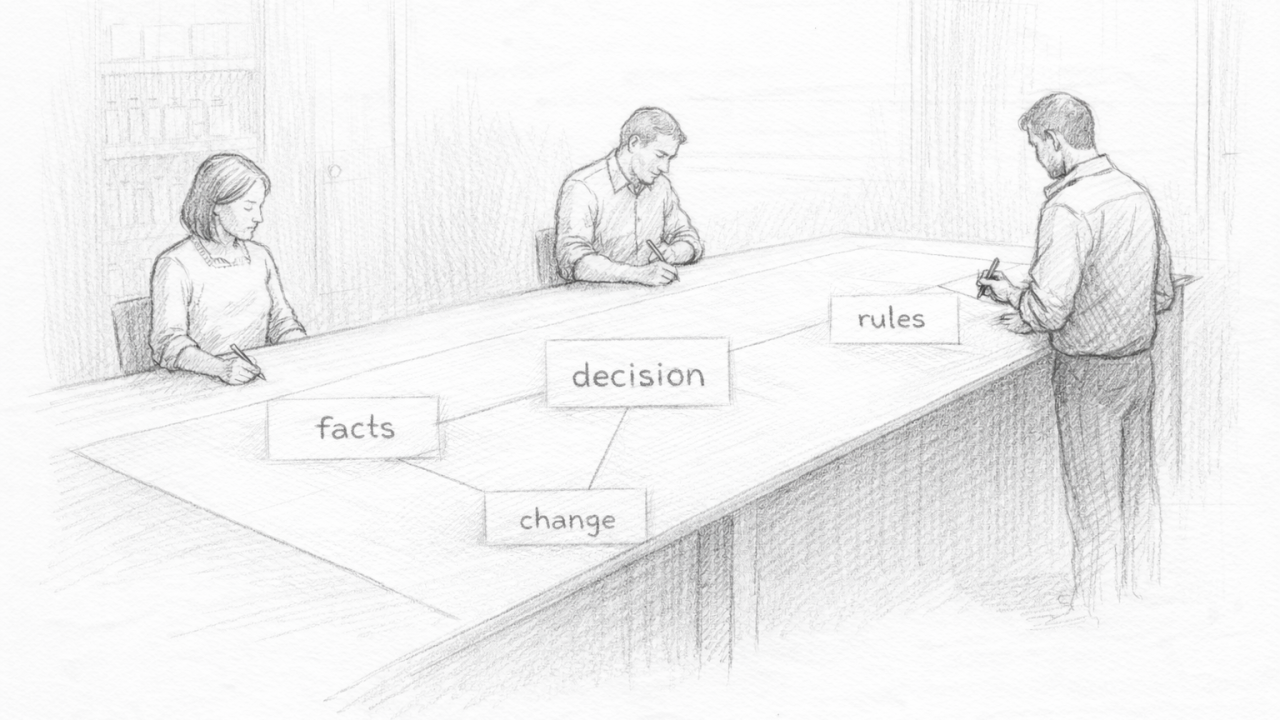
When facts are explicit, governance does not need to ask who changed something. It can see which facts were produced, by whom, and when. When decisions are explicit, governance does not need to enforce accountability retroactively. Responsibility is already clear. When authority boundaries are visible, escalation paths no longer need to be invented under pressure.
Most governance models assume that safety comes from restriction. Models demonstrate that safety comes from clarity.
This is why attempts to “add governance” to systems that lack a shared model tend to increase cost without increasing confidence. Reviews multiply. Documentation grows. Approval chains lengthen. Yet uncertainty remains, because the underlying structure that would make those controls meaningful was never made explicit.
In contrast, when a shared model exists, governance becomes almost unremarkable.
Audits stop being interrogations and start becoming inspections. Compliance stops being a parallel process and becomes an observable property of the system. Conversations shift from “Was this allowed?” to “Was this decision made where it belongs, based on the right facts?”
This does not mean that models replace governance. It means they make governance possible.
Governance without a model is forced to operate through proxies: documents, checklists, controls, and after-the-fact evidence. Governance with a model can operate directly on the structure of decisions and responsibilities. The former governs behavior. The latter governs understanding.
And understanding, once shared, rarely needs enforcement.
This is why models age better than governance rules. Rules accumulate. Models evolve. Rules harden around past failures. Models adapt to current reality. Governance frameworks tend to grow heavier over time, while good models tend to grow clearer.
In earlier posts, I wrote about the quiet cost of starting execution too early, about trust and compliance as design problems rather than control problems, about facts and decisions as the true seams in a system, about change as a first-class concept in the model, and about autonomy as clarity of decision-making rather than independence.
All of those threads point to the same underlying insight. Governance fails when it is asked to compensate for missing understanding. It succeeds when it is grounded in a shared model that makes intent, authority, and responsibility visible before action begins.
When facts are explicit, decisions are owned, change is modeled, and autonomy is real, governance no longer needs to intervene late or loudly. It becomes almost incidental — not because risk has disappeared, but because it is understood.
That is why governance cannot be bolted on after the fact. It has to emerge from the same structure that enables trust, safe change, and autonomy in the first place.
And that is why most governance models fail where models do not.
Originally published on LinkedIn (2026-02-09): https://www.linkedin.com/pulse/why-most-governance-models-fail-dont-gabriel-n-schenker-pzwze