There is a strange paradox in modern software delivery.
We have never had more visibility into the work. We have roadmaps, backlogs, Jira boards, Confluence pages, architecture diagrams, release plans, OKRs, steering committees, risk registers, test reports, dashboards, incident reviews, dependency maps, delivery updates, and status meetings.
And still, in many organizations, nobody really sees the full picture.
People see fragments.
The product owner sees priorities, customer needs, stakeholder expectations, and maybe the next few milestones. The business analyst sees requirements, process descriptions, edge cases, and unresolved questions. The architect sees components, integrations, data flows, constraints, and technical trade-offs. The engineers see implementation details, APIs, data models, tests, pipelines, and operational concerns. The QA people see scenarios, gaps, regressions, and ambiguities. Security sees access, data exposure, threats, and control points. Compliance sees obligations, evidence, approvals, and audit risk. Operations sees failure modes, support processes, monitoring gaps, and production pain.
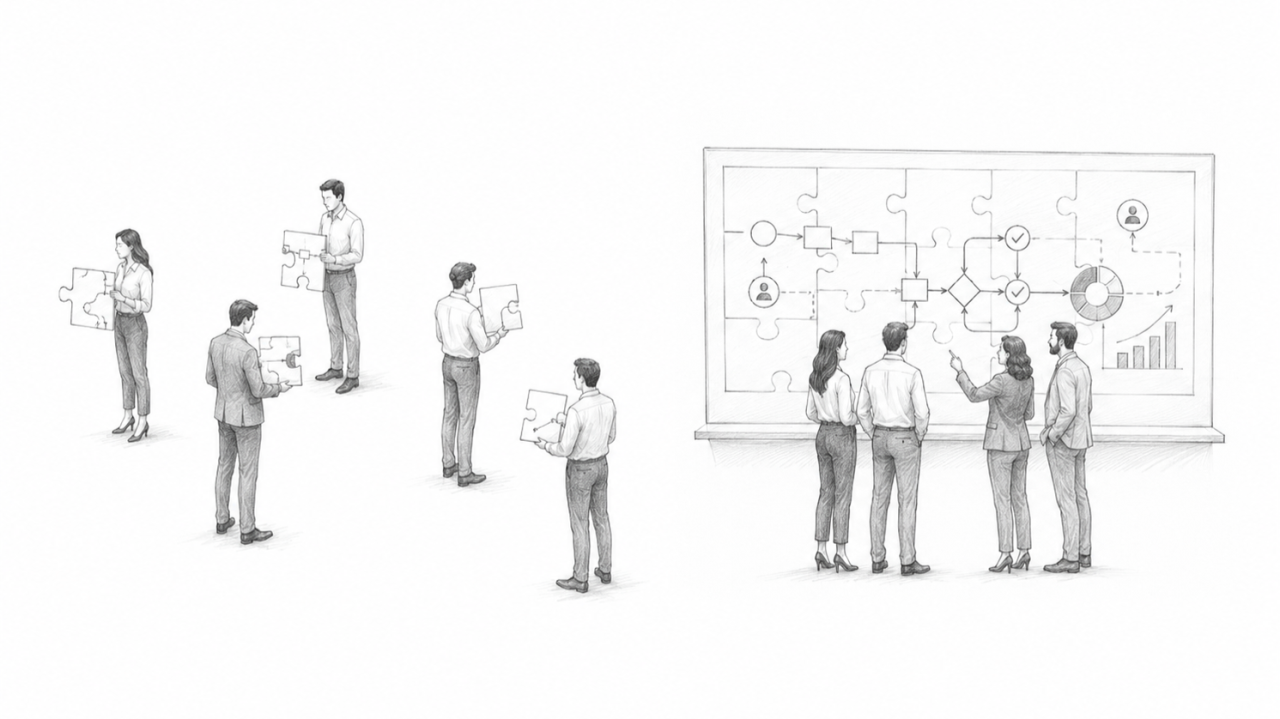
All of these views are valid. None of them is enough on its own.
The problem is not that people are careless. It is not that teams are lazy. It is not even that organizations lack documentation. Very often, the opposite is true. The problem is that the documentation, the plans, the tickets, the diagrams, and the meetings do not add up to one coherent business solution.
They add up to a lot of local truths.
That is a very different thing.
The full picture is not the sum of all tickets
One of the biggest misconceptions in delivery organizations is the belief that if every piece of work is tracked, then the whole solution is understood.
This is false.
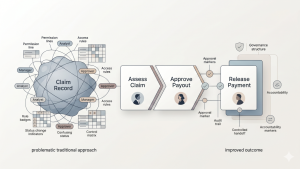
A backlog can be complete and still fail to explain the business solution. A Jira board can be up to date and still hide the most important uncertainties. A project plan can be green and still say very little about whether the product behavior makes sense. A technical architecture can be accurate and still not explain the customer journey, the business policy, the compliance obligation, or the operational consequence.
Tickets are useful. They help teams execute. They help work move through a system. They help individuals understand what they are supposed to do next.
But tickets are a terrible place to understand the whole.
They fragment intent into small units of work. They separate business reasoning from technical execution. They age quickly. They mix decisions, assumptions, comments, acceptance criteria, dependencies, and implementation notes. They often describe what someone should build, but not why the solution must behave that way. They rarely show how a business process unfolds over time.
A ticket may say: “Add validation for field X.”
But the real business question may be: Why does this field matter? Who depends on it? What decision is made with it? What happens if it is missing? Is it required for compliance? Does it affect pricing, eligibility, claims, reporting, or audit evidence? Is the validation the same in every country, every product, every partner journey, and every point in time?
The ticket is small because delivery needs small units. But the business meaning is often much larger.
When the business meaning is not modeled somewhere else, the ticket quietly becomes the source of truth. That is when the trouble starts.
We confuse activity with understanding
A lot of organizations are very busy managing work.
They plan. They refine. They estimate. They align. They escalate. They report. They re-plan. They update. They synchronize. They review. They ask for status. Then they ask for status again in a different format.
Some of this is necessary. Complex work needs coordination. But much of this activity exists because the underlying design is not visible enough.
We need more status meetings because nobody can see the real status from the artifacts. We need more alignment meetings because the shared model is weak. We need more dependency tracking because the boundaries of the solution are unclear. We need more project coordination because the work has been sliced technically, but not understood as business behavior. We need more governance checkpoints because risks, decisions, and obligations are not attached to the design itself.
In other words, some of our process is not process at all.
It is compensation.
It compensates for missing clarity. It compensates for fragmented ownership. It compensates for the lack of a shared, inspectable picture. It compensates for the fact that different roles are looking at different surfaces of the same problem and calling their view “the truth.”
This is why organizations can spend enormous energy managing delivery and still be surprised late in the process.
A compliance issue appears. A security concern changes the flow. A business rule was misunderstood. A report cannot be produced. A manual operations step was forgotten. An exception path was never designed. A customer journey works in the happy path, but breaks under real conditions. An audit question cannot be answered without reconstructing the story from scattered tickets, Slack messages, meeting notes, and tribal knowledge.
The work was managed.
But the solution was never truly seen.
The silo problem starts earlier than we think
When people talk about silos, they often talk about departments: business, IT, security, compliance, operations, data, support.
But the deeper silo is not organizational. It is cognitive.
Each role is trained to see a different part of the problem.
That is useful. We need those different perspectives. A business expert notices things an engineer may miss. A tester sees ambiguity that others skip over. A security specialist sees misuse cases. A compliance person sees obligations that cannot be negotiated away. An operations person sees what will happen on a Friday evening when the process gets stuck and the customer is waiting.
The issue is not that these perspectives exist. The issue is that they are often applied sequentially, locally, and too late.
Business defines something. Product turns it into backlog items. Architecture reviews the solution shape. Engineers implement. QA tests. Security reviews. Compliance checks. Operations inherits. Data teams try to report on it. Auditors later ask for evidence.
This looks like collaboration from a distance. In reality, it is often a chain of partial translations.
With each translation, context is lost.
The original business intent becomes requirements. Requirements become tickets. Tickets become implementation. Implementation becomes test cases. Test cases become release evidence. Production behavior becomes dashboards and incidents. Auditability becomes a reconstruction exercise.
At every step, the language changes. The artifact changes. The ownership changes. The level of detail changes.
And somewhere along the way, the full picture disappears.
We turn business problems into technical problems too early
This may be the most damaging habit in the SDLC.
A business problem arrives, and almost immediately we start translating it into technical work.
We ask which service must change. Which database table is affected. Which API must be extended. Which frontend component is needed. Which integration must be adjusted. Which team owns the change. Which sprint can take it. Which epic should contain it.
These are legitimate questions. But they are not the first questions.
Before a business problem becomes technical work, it should be understood as a business solution.
What outcome are we trying to create? Which business capability is involved? Which customer or user journey changes? Which decisions must be made? Which policies apply? Which obligations must be respected? Which events matter? Which states can the process be in? Which exceptions are possible? Which controls are required? Which evidence must exist later? Which business metrics should tell us whether the solution works?
If we skip these questions, we do not save time. We simply push the cost downstream.
The cost appears later as rework, meetings, defects, escalations, unclear ownership, manual controls, brittle processes, missing evidence, and operational pain.
This is one of the reasons large organizations feel slow. It is not always because people are slow. It is because the system forces them to rediscover the same business context again and again, from different fragments, in different rooms, at different stages of delivery.
The missing artifact is the business solution model
Most organizations have many artifacts, but often not the one that matters most.
They have requirement documents. They have architecture diagrams. They have tickets. They have test cases. They have process flows. They have dashboards. They have risk assessments. They have decision logs, sometimes. They have audit evidence, eventually.
But where is the living model of the business solution?
Where can a product owner, engineer, architect, tester, compliance expert, security specialist, and operations person stand together and see the same thing?
Where can they point to a customer action, a business event, a policy decision, a system response, an exception path, a control, an audit-relevant fact, and an operational signal as parts of one coherent story?
Where can they see not only what is being built, but why it behaves the way it does?
This is not a call for another document template. That would only add to the problem.
The business solution model should not be a static document written once and forgotten. It should be a shared thinking tool. It should make the important parts of the solution visible. It should be understandable by business people and useful to technical people. It should show behavior over time. It should expose decisions, rules, risks, controls, and evidence needs. It should support delivery without becoming delivery bureaucracy.
This is where practices like EventModeling, business process modeling, example mapping, domain storytelling, decision modeling, and well-written business-readable scenarios become interesting. Not because any one method is magic, but because they all try to address the same gap: they make business behavior visible before it is scattered into implementation tasks.
Governance without a full picture becomes theater
Governance is necessary. Especially in regulated environments. Nobody should pretend otherwise.
But governance becomes expensive and frustrating when it governs fragments instead of the solution.
If governance only looks at documents, approvals, stage gates, and status reports, it may create the appearance of control without creating real understanding. People can comply with the process while still misunderstanding the business behavior. They can produce the required artifacts while leaving important questions unresolved. They can pass the checkpoint while carrying hidden risk into implementation or production.
Good governance should not ask only: Was the process followed?
It should ask: Is the business solution understood? Are the important decisions explicit? Are the assumptions visible? Are the risks attached to the design? Are the compliance obligations reflected in behavior? Are the security constraints part of the journey? Is the audit evidence designed in? Will we be able to observe whether the process works in production?
These questions are harder. They are also more useful.
The irony is that better business solution design can make governance lighter, not heavier. When the design is visible, many governance questions can be answered from the model itself. When obligations, controls, decisions, and evidence are connected to the business flow, governance does not need to chase the truth across twenty disconnected artifacts.
Observability also belongs in the business picture
Observability is usually discussed as a technical topic. Logs, metrics, traces, dashboards, alerts, service health.
That matters. But it is not enough.
A business solution can be technically healthy and still business-broken.
The services may be up. The APIs may respond quickly. The database may be fine. The infrastructure may be green. And still, customers may be stuck. Applications may not convert. Claims may sit in manual review. Refunds may be delayed. Exceptions may pile up. Compliance-relevant steps may fail silently. A partner journey may create strange patterns nobody sees until someone complains.
Business observability asks different questions.
Where are we losing customers? Where does the process slow down? Which decisions create the most manual work? Which exceptions happen more often than expected? Which controls fail or create friction? Which policies produce unexpected outcomes? Which parts of the journey look fine technically but fail commercially or operationally?
These questions cannot be bolted on at the end. They must be part of the business solution design.
If a process matters, we should design how we will see it.
The full picture is a social achievement
There is one more important point.
The full picture is not created by a single role.
Not by the architect. Not by the product owner. Not by the business analyst. Not by the engineer. Not by QA. Not by compliance. Not by security. Not by operations.
Each of these roles sees something important. Each also misses something.
The full picture emerges when these perspectives meet around the same model early enough, often enough, and concretely enough.
This is why I am increasingly convinced that business solution design must become a joint discipline. Not a handover from business to IT. Not a document written by one role and consumed by others. Not a meeting where everyone gives their update and leaves with the same assumptions they had before.
It must become the place where the organization thinks.
That sounds abstract, but it is practical. Very practical.
It means modeling the business flow before slicing it into technical tasks. It means discussing examples instead of only abstract requirements. It means making policies and decisions visible. It means asking what evidence will be needed later. It means treating security and compliance as part of the business behavior. It means designing operational visibility from the start. It means keeping the model alive as understanding changes.
Most importantly, it means refusing to accept local clarity as a substitute for shared understanding.
Seeing the whole is not optional anymore
The more complex the business, the more dangerous fragmentation becomes.
In simple systems, local optimization may be tolerable. In regulated, digital, data-driven, AI-assisted, highly integrated businesses, it becomes a serious risk.
A small change in one part of the journey can affect eligibility, pricing, customer communication, consent, reporting, claims, accounting, compliance evidence, operational workload, and partner experience. If those connections are not visible, the organization does not really know what it is changing.
That is why “seeing the full picture” is not a luxury. It is not an architectural preference. It is not a documentation concern.
It is a business capability.
Organizations that cannot see their own business solutions clearly will compensate with more process, more coordination, more governance theater, more status reporting, and more late discovery.
Organizations that can see the full picture can move differently.
They can govern with more confidence. They can reduce unnecessary process. They can involve the right people earlier. They can design for auditability instead of reconstructing it. They can treat compliance as behavior, not paperwork. They can observe business outcomes, not only system health. They can make better trade-offs because they understand the shape of the problem.
The goal is not to remove discipline from the SDLC.
The goal is to put the discipline where it belongs: into a shared, living understanding of the business solution.
Because when nobody sees the full picture, every role does the best it can from its own fragment.
And that is exactly how organizations end up with a lot of activity, a lot of process, a lot of tickets, a lot of meetings, and still no shared understanding of what they are really building.
Originally published on LinkedIn (2026-06-12): https://www.linkedin.com/pulse/why-nobody-sees-full-picture-gabriel-n-schenker-ouwce