In theory, EventModeling should be a perfect fit for large organizations.
It creates shared understanding, removes ambiguity, and aligns business and technology around a single, explicit view of how the business actually works.
And yet, in practice, it often fails to be fully adopted.
One reason is perception.
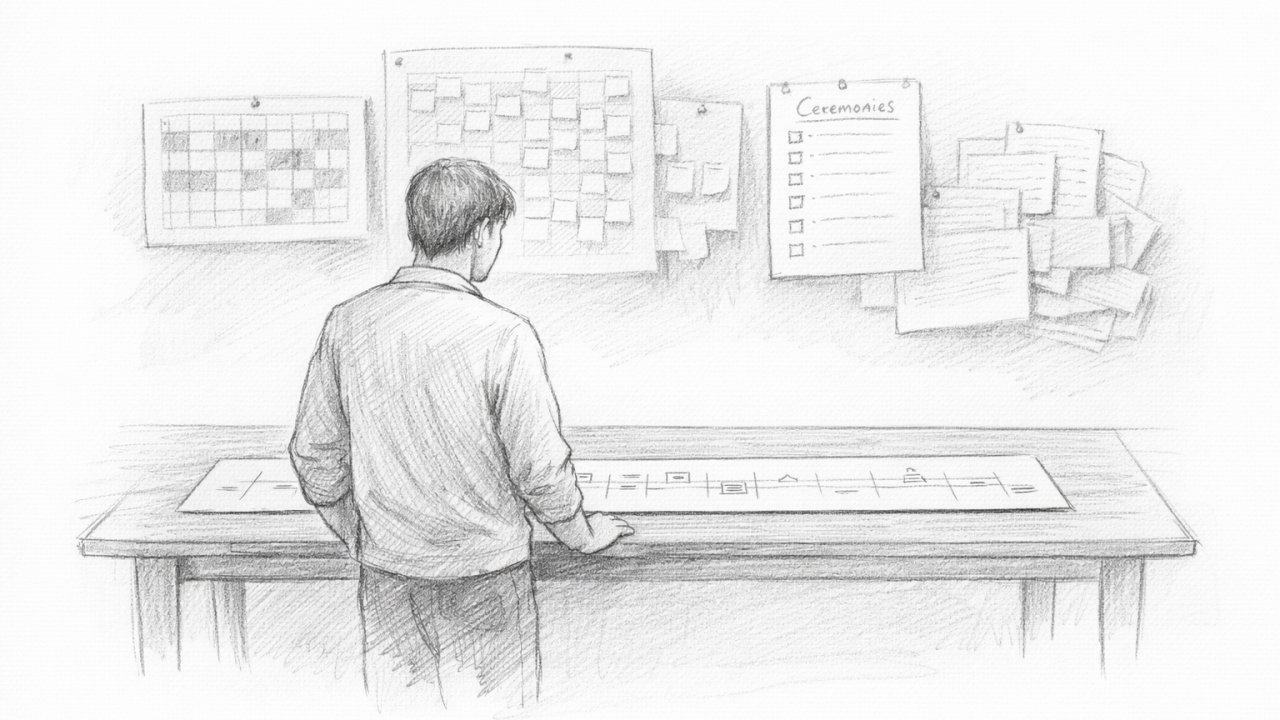
EventModeling is frequently seen as yet another process added on top of an already overloaded software development life cycle (SDLC). Enterprises are drowning in ceremonies, artifacts, and governance layers — so anything new is immediately treated as “more overhead.”
But this misses the point entirely.
Another reason is misuse.
EventModeling is often pulled into the realm of technical solution design. People start smuggling implementation details, architectures, APIs, and technologies into the model. At that point, non-technical stakeholders disengage — and the model loses its real power.
EventModeling is NOT a technical design tool.
It is a way to capture the business process we want to automate — in a technology-agnostic, human-readable form.
And yes, we can annotate models with technical hints.
But the primary goal is alignment: a shared understanding of the business process, the actors involved, the systems, the information flowing through them, and the business rules that govern all scenarios.
When an EventModel is information complete — when every state change, every incoming and outgoing piece of information, and every business rule is explicit — ambiguity disappears.
This becomes our jointly agreed truth at a given moment in time.
And that truth is owned collectively. Not by a single role. Not by a single team. But by everyone who participates in shaping the business.
This is also why the idea that “the code is the source of truth” is a fallacy.
Code excludes most stakeholders by definition. Even experienced engineers (myself very much included) cannot reliably reconstruct complex business processes by reading code alone — no matter how elegant that code may be.
EventModeling doesn’t add complexity to the SDLC. It removes it.
Once an EventModel is information complete and sliced vertically, many of the rituals we take for granted simply become unnecessary. Sprint planning, backlog grooming, estimation poker, endless alignment meetings, Jira hygiene — they exist largely to compensate for missing shared understanding.
With EventModeling, that understanding is already there. Each slice becomes a clear, autonomous unit of work. A developer doesn’t need to ask what to build, why it exists, or how it fits into the bigger picture — it’s all visible. Because these slices follow consistent patterns, complexity becomes predictable. Delivery becomes predictable.
And progress becomes visible without dashboards, reports, or tooling gymnastics — simply by looking at the model.
Perhaps the real reason EventModeling struggles in enterprises is not that it asks too much.
It’s that it quietly questions many roles, tools, and rituals we’ve built careers around.
Prior posts in the series:
- Post 1: We lack a shared language and blueprint
- Post 2: We can work with a small set of repeatable building blocks
- Post 3: We need a living map for the enterprise
- Post 4: When “change state” quietly reshapens our boundaries
- Post 5: Where does a domain get the facts it needs to make a decision?
- Post 6: Boundaries Follow Decisions, Not Data
- Post 7: When software makes simple business decisions hard
- Post 8: Why Systems Forget What the Business Never Did
Originally published on LinkedIn (2026-01-08): https://www.linkedin.com/pulse/why-eventmodeling-still-struggles-enterprise-gabriel-n-schenker-1rwre